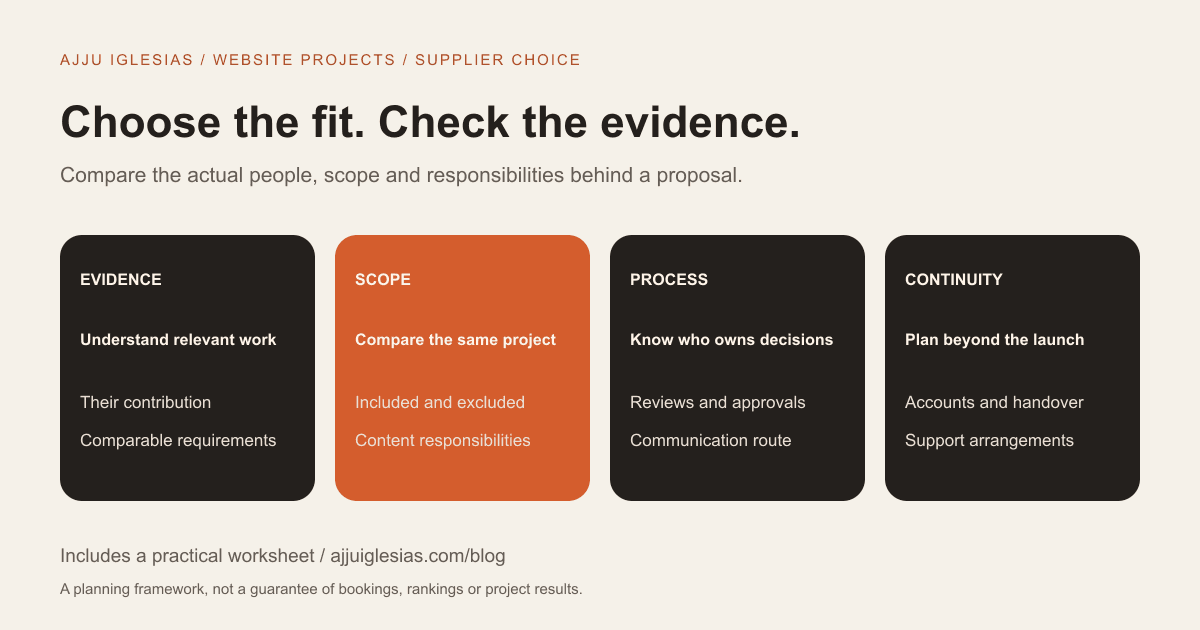
Choose a freelance web designer or an agency by comparing the people, process and support your project needs. The label alone does not tell you who will do the work, how well they understand your business or what happens after launch.
A focused website can suit a capable independent professional. A project needing several specialist disciplines may benefit from a coordinated team. Both arrangements can work well, and both can become difficult when scope, communication or ownership is unclear.
This guide provides a practical comparison for small businesses commissioning a website, redesign or content-management project. Use the website supplier comparison worksheet to compare actual proposals rather than stereotypes about price or quality.
Start with the work required
List the outcomes and deliverables before choosing a supplier model. A supplied-content brochure site, an ecommerce rebuild and a hotel website with reservation integration need different skills and coordination.
Ask which parts are already solved. You may have approved copy, photographs and a brand system, or you may need help producing all three. The right supplier needs to cover the actual gaps.
A website brief makes this visible. It should identify the audience, main action, pages, workflows, content responsibilities and constraints.
When the brief is unclear, different suppliers may quote different projects under the same title. That makes the freelancer-versus-agency comparison look more decisive than it really is.
Understand a freelancer's arrangement
An independent designer or developer may provide direct access to the person doing the core work. That can make it easier to discuss details, understand tradeoffs and keep feedback close to implementation.
Check the specific skill mix. Some freelancers focus on design, some on development, and some deliver a broader service. A portfolio containing a complete website does not by itself identify which parts that person handled.
Ask whether any work is subcontracted or completed with regular collaborators. That can be a perfectly useful arrangement, but you should understand who is responsible for communication and delivery.
Also discuss availability. An independent professional has finite capacity, so the project needs a realistic schedule, an approach to absence and clarity about ongoing support.
Understand an agency's arrangement
An agency may coordinate several specialists through a shared process. That can help when a project requires distinct design, development, content, photography or marketing work.
Find out who is actually assigned. A presentation by a senior person does not necessarily mean that person will work on the website. Ask how the team is structured and who owns the decisions.
An account or project manager can reduce coordination work for the client when the role is useful and clear. It can also add an extra communication step. Judge the proposed working process rather than assuming either effect.
Ask about external contributors as well as employees. The business needs clear responsibility for the complete outcome regardless of how the supplier organises its team.
Compare relevant evidence
Choose examples resembling the work you need: similar user decisions, content complexity or integrations. A visually impressive site in a different category can still be useful, but it is not automatic evidence that the supplier has solved your requirements.
Ask what the supplier contributed. Was it design, development, copywriting, a template adaptation, ongoing care or the whole project? A clear answer is more informative than a collection of screenshots.
Discuss the reasoning behind a project. What requirements shaped the structure? What was deliberately excluded? How did the client update content after launch?
If outcomes are presented, ask what was measured and over what period. A claim of commercial improvement should have evidence and context. Do not infer revenue or enquiry growth from a before-and-after image.
You can explore selected website projects to start a discussion about relevant design and development work.
Examine the proposed process
Ask how the supplier moves from a brief to a launch. Useful stages can include discovery, structure, content preparation, visual design, development, testing and handover.
The sequence should make decisions visible early enough to change them sensibly. If the first review happens only after the site has been built, major structural feedback can become expensive to resolve.
Find out how feedback is collected and approved. A single consolidated response from the client can be easier to manage than contradictory messages from several people. The process should identify who resolves those differences.
Neither a freelancer nor an agency automatically has the better process. Ask for an explanation tied to your project's actual stages and dependencies.
Compare like-for-like costs
There is no reliable rule that an agency is always more expensive or that a freelancer is always the better value. Quotes can differ because they include different work, specialist involvement, support or assumptions.
Compare initial work, external tools, content production, revisions, launch support and recurring costs separately. Ask what would trigger an additional estimate.
A low number can exclude work another proposal includes. A high number still needs a clear account of the responsibilities and deliverables you receive. Price alone does not establish either quality or suitability.
For practical scope questions, use the guides to landing-page costs and redesign costs. Their budgeting examples are illustrative, not market rate cards.
Find out who makes decisions
Identify the person who can answer technical or design questions and the person who can agree a scope change. Sometimes those are the same person; sometimes they are not.
Ask how often progress is reviewed, which communication channel is used and where approvals are recorded. You should know how to raise an issue without creating several parallel conversations.
On your side, choose a project owner who can gather content and consolidate decisions. Supplier coordination cannot fully compensate for a client team with no approval process.
A useful test is to describe an actual uncertainty from your brief and see how the supplier proposes resolving it. The response can reveal more about the working relationship than a generic promise of excellent communication.
Check content responsibility
Confirm who writes, edits, supplies and approves the content. A developer building pages from final copy is providing a different scope from a team helping define the offer and create the material.
Discuss photography, brand files, translations and project evidence where relevant. Avoid assuming that a broader supplier label means all of those services are included.
Identify what needs to exist before design or development can progress. If content arrives late, ask what changes about the schedule or interim work.
The proposal should distinguish assistance from ownership. “We help with content” can mean advice, editing or full production. Get the meaning clear before comparing it with another offer.
Inspect testing and handover
Ask which user journeys are tested and who approves the results. A launch review should include the site's intended tasks, such as submitting an enquiry or following a booking path.
Test the editing experience too. The client should be able to perform the agreed routine tasks, and the supplier should explain any limits or training needs.
Handover can include account access, documentation, renewal responsibilities and a walkthrough of the content system. Discuss the intended source-code and asset arrangements in the project agreement rather than relying on an assumption about supplier type.
Both models should explain who handles an issue discovered after launch. A polished proposal is incomplete if responsibility ends at an undefined point.
Plan for continuity
Ask how the supplier handles absence, overlapping projects or a change in the people assigned. A freelancer may have an agreed backup arrangement; an agency may have a defined internal handover process. Check the real arrangement.
Documentation and account ownership also matter. Important operational knowledge should not exist only in one person's inbox.
Clarify access to the domain, hosting and connected services. The business needs to understand which accounts it owns and which depend on a supplier's continuing package.
Continuity does not mean assuming every supplier will disappear. It means making the normal working arrangement understandable enough that another responsible person can take over when necessary.
Define ongoing support
A website project and a maintenance service can have different terms. Ask whether the supplier offers continuing care, what it covers and how new development is estimated.
Response times, support hours, form checks, backups and content changes should be discussed directly. “Support included” does not explain all those responsibilities.
Use the WordPress maintenance plan checklist to frame the questions, even if your eventual platform differs. The central issue is who owns each continuing task.
A supplier who clearly states what they do not cover can be easier to work with than one offering an unlimited promise with no operational detail.
Use a fair comparison method
Prepare the same brief for each shortlisted supplier. For each proposal, record the included work, the evidence supporting it, unresolved questions and any conditions.
A simple rating can help organise a discussion, but do not treat an arbitrary total as an objective prediction of success. One unresolved critical requirement can matter more than several minor preferences.
For example, a hotel may consider a verified reservation integration essential. Strong visual references cannot compensate for a supplier who has not explained that requirement.
Use the worksheet to record a decision rationale in plain language: why this proposal fits, what risks remain and how they will be managed.
Two illustrative project choices
Imagine a consultant with a clear offer, approved content and a small set of pages. The main needs are thoughtful design, a reliable enquiry path and straightforward editing. A suitable freelancer with those skills and available capacity could be a sensible fit.
Now imagine a business changing its brand presentation, rewriting a large content library, rebuilding an online store and coordinating campaign material. A team arrangement may make specialist coordination easier if the assigned people and responsibilities are clear.
These examples do not establish a rule by company size or budget. A freelancer with collaborators may cover a broad scope, while a small agency may focus on a narrow service. Evaluate the actual proposal.
The question is which arrangement leaves the business with the right work completed and a manageable process, not which label sounds more impressive.
Questions worth asking
Use real project details when asking:
- Which work will you personally or directly deliver?
- Who is assigned to the other required disciplines?
- What assumptions does this proposal make about our content?
- How will we review structure before the final build?
- How are scope changes agreed and estimated?
- What acceptance tests will you run?
- What accounts, documentation and training are handed over?
- What support is available after launch?
- How will the project continue if the assigned person is unavailable?
- Which part of our brief is currently the greatest uncertainty?
Ask follow-up questions when an answer stays generic. A supplier should be able to explain both its strengths and the requirements that need more investigation.
Watch for unclear commitments
Be cautious about promises that cannot be tied to deliverables: guaranteed ranking positions, an unexplained instant turnaround or unlimited work without a defined scope.
An incomplete answer is not automatically a reason to reject a supplier. Sometimes the brief genuinely needs discovery. The useful distinction is whether the uncertainty is acknowledged and a sensible next step is proposed.
Also review the assumptions on your own side. A late approval, missing photography or an unconfirmed integration can affect any supplier model. A fair comparison considers both sides of the working relationship.
Choose the proposal you can understand
The strongest choice is the supplier whose evidence, people, process and responsibilities fit the project. You should be able to explain what will be delivered, what your team must supply and what happens when requirements change.
If direct collaboration on a focused design or development project suits your needs, send your brief and review the web design service. We can discuss whether the scope is a fit and identify any specialist work that needs a different arrangement.
The comparison framework and examples here are editorial guidance. They do not claim that every freelancer or agency works in the same way or that a particular supplier model guarantees better results.