Landing-page design cost in India depends on what the page must accomplish and how much work is required to make that journey function. A page with supplied copy and a working form is a different project from a campaign page needing research, writing, custom design, integrations and measurement.
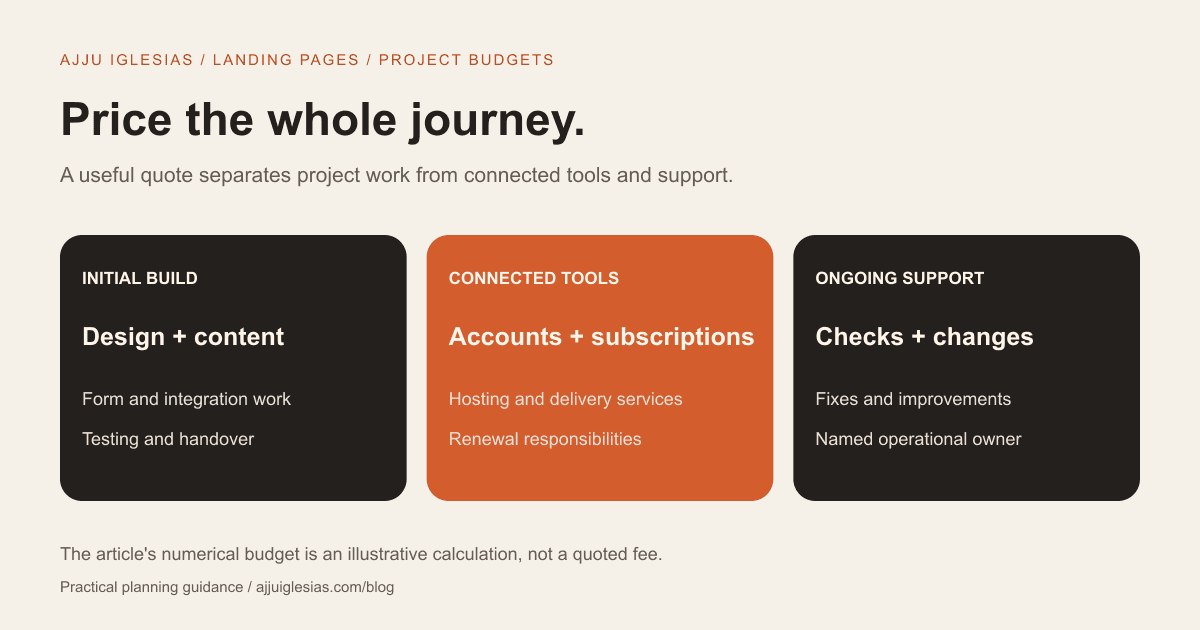
A useful quote separates those responsibilities. It should explain the initial build, any third-party costs and what support continues after launch.
This guide is a scope-based budgeting framework. It does not claim a national average or publish an unverified starting price for my services. It includes a clearly hypothetical calculation and a landing-page quote worksheet to help you compare proposals.
What are you paying to build?
Define the visitor and the action before discussing price. A consultation page, an event-registration page and a product checkout page can all be called landing pages, but they involve different information and workflows.
Write the traffic source too. Someone arriving from a specific advert needs the page to continue that promise. A visitor comparing suppliers may need deeper evidence about scope and delivery.
Decide what happens after the main action. A form might send a notification, create a CRM record or route requests to different teams. Those requirements affect development and testing even when the visible page is short.
Use the website brief template to describe the purpose and any unknowns. The developer can then propose a scope rather than price an ambiguous “single page.”
What changes the design cost?
A ready-made layout adapted to your content and an original page designed around a particular offer require different amounts of design work. Neither is automatically the right option for every business.
Custom work may involve examining the offer, planning the information sequence, creating wireframes, refining the visual design and reviewing mobile layouts. The amount of content and the number of different page sections also matter.
Explain which assets you have. A usable brand system, current photographs and approved copy reduce uncertainty. If those need creating, ask whether the design fee includes them or whether another supplier is responsible.
Be precise about review stages. The proposal should describe what is reviewed, who consolidates feedback and how changes outside the agreed scope are handled.
Copy is part of the scope
A headline, offer explanation, proof section and form instructions all influence whether a visitor understands the page. “We will supply the content later” does not tell a developer how much writing work is needed.
List whether copy is final, rough or missing. Ask who develops the structure and who approves factual claims, testimonials and product information.
A supplier adapting supplied copy may be quoting a different service from one researching and writing the page. Compare the responsibilities before comparing the headline total.
Avoid paying for impressive claims that you cannot support. Use relevant work, accurate descriptions and genuine customer evidence. If the page currently gets traffic but few responses, the enquiry diagnostic checklist can help identify whether messaging is the actual problem.
Forms and integrations add work
A basic request form needs more than a submit button. It needs validation, a confirmation state, a delivery destination and testing. Spam controls and a usable error path also need consideration.
A CRM connection, appointment scheduler, payment step or multi-stage qualification flow expands the scope. Ask whether the quoted work includes account setup, configuration, integration, test cases and handover.
Describe the workflow in plain language. For example: “A prospect requests a consultation. We store the request, notify the sales inbox and send an acknowledgement. A person then reviews suitability.” That is clearer than asking for “lead automation.”
Third-party tools have their own costs and product limits. If a scheduler is proposed, review the current provider terms and the specific plan rather than assuming everything shown in a demonstration is included.
Measurement must be defined
Agree which actions should be recorded. Page views, contact-button clicks, received forms and qualified enquiries are different stages.
A measurement setup may include event planning, implementation, consent considerations and test submissions. Ask what is included and whether the supplier will verify that events correspond to successful actions.
Do not assume analytics can identify every visitor or that a click proves a lead was received. Your team still needs a record of real enquiries and their suitability.
Google documents a recommended generate_lead event for enquiries. Its availability does not mean it is automatically configured correctly on your website. Use the event after the relevant successful action and keep personal contact details out of analytics parameters.
An illustrative budget calculation
Suppose a hypothetical project is planned at 24 working hours and an assumed rate of ₹1,000 per hour. That produces ₹24,000 for the described work before any separately agreed taxes or third-party charges. This is an arithmetic example, not a market price, a project estimate or my quoted fee.
For illustration, those hours might be allocated as follows:
- Discovery and page structure: 3 hours.
- Design and mobile layouts: 6 hours.
- Build and form setup: 9 hours.
- Testing and handover: 4 hours.
- Consolidated revisions: 2 hours.
The useful step is checking what is inside the allocation. In this example, new photography, extensive copywriting, a complex CRM integration and continuing support have not been included.
If the actual workflow needs those items, the assumptions change. A fixed-price proposal may not disclose hourly calculations, but it should still make deliverables and exclusions clear enough to compare.
Separate launch cost from running cost
Ask which costs recur after the build. Possible items include hosting, domain renewals, form tools, scheduling software, email delivery services, support and future changes.
Record the account owner and billing arrangement for each item. A subscription paid directly by your business differs from one bundled into a supplier's service package.
Ask what happens when an account expires or you end a support arrangement. The page should have a clear operational owner, and the handover should explain what needs renewing and monitoring.
Do not assume that a low initial fee means low total ownership cost. Equally, a larger quote needs a clear explanation of the work and support being supplied.
Compare three meaningful options
A focused first release can use supplied content, a standard visual system and a single validated enquiry path. That can be appropriate when the offer is already clear and the team mainly needs reliable execution.
A custom campaign page can add offer research, original design, writing support and deeper measurement. It fits a project where the page's structure and message need development as well as implementation.
An integrated conversion journey can add scheduling, payment, qualification or CRM workflows. Its quote should cover those systems and the exceptions, not just the front-end page.
These are scope categories rather than price tiers. Ask a supplier to explain which option solves your actual task and which features can wait.
Check the quote before accepting it
Use the worksheet to ask:
- Who supplies and approves copy and images?
- What design and mobile review stages are included?
- Which forms and integrations will be delivered?
- How will delivery and successful actions be tested?
- What changes are covered by the revision allowance?
- Which accounts and recurring costs remain your responsibility?
- What documentation and training will you receive?
- What support is included after launch?
If two quotes use different assumptions, ask for a revised scope before treating them as comparable. “Unlimited revisions” or “fully optimised” needs an operational explanation, not just a marketing label.
Avoid a false economy
The cheapest page can still be expensive if enquiries fail to reach the right person or if your team has to rebuild it immediately. The risk comes from untested requirements and unclear responsibility.
Before spending more on traffic, verify the page on a phone and submit an end-to-end test enquiry. Read the confirmation message and confirm the request reaches its destination.
A landing page can also be the wrong purchase. If visitors need to compare several services or inspect a substantial portfolio, improving the relevant service pages may be more useful than creating a separate campaign page.
Prepare a useful quote request
Send the offer, audience, traffic source, target action, available assets, integration requirements and preferred launch date. Include a budget range if you have one and identify the decisions you need advice on.
For a scoped conversation, request a landing-page quote and review the landing-page design service. The aim is to agree what the page must deliver before attaching a price to it.
References and assumptions
The worked budget is deliberately hypothetical. No country-wide rate or conversion improvement is claimed. The worksheet and scope comparisons are editorial planning tools.
Provider documentation checked on 14 October 2026:
- Google Analytics recommended events describes optional event measurement, including generate_lead.
- Zoho Bookings is an example of appointment-scheduling software. Check the chosen product's current plan, integration options and fees when budgeting.
These references support measurement and integration planning; they are not sources for the illustrative development rate.