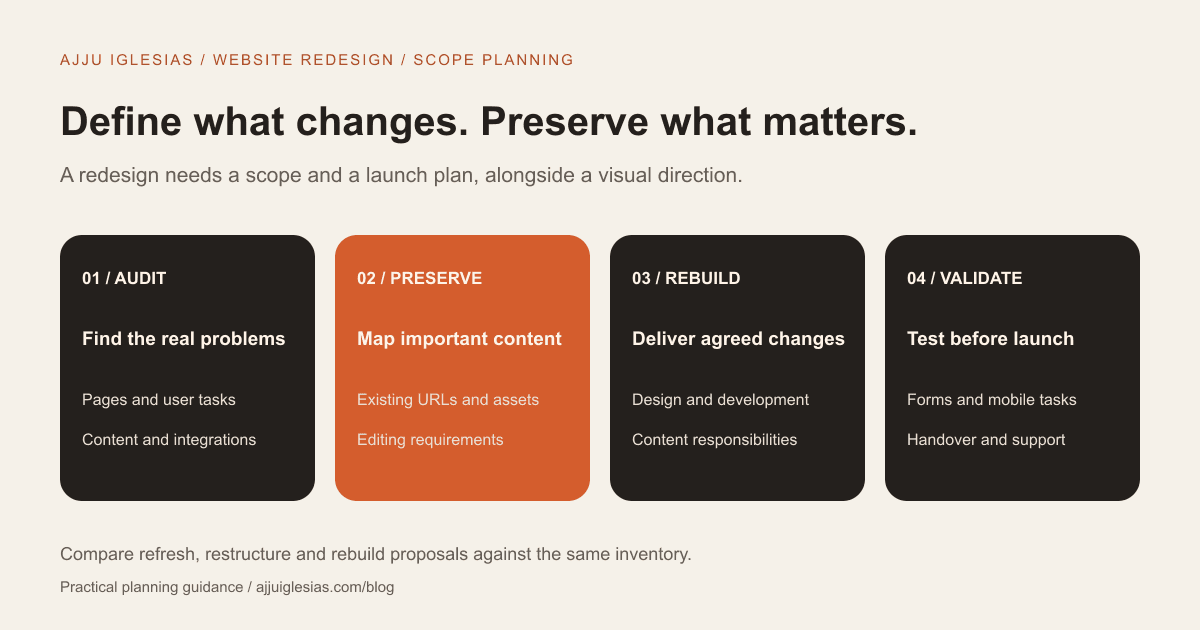
Website redesign cost in India depends on how much of the existing site must change and what must be preserved. Updating a visual system, reorganising service pages and moving a website to a different platform are different projects, even if the final screen looks similar.
A useful quote accounts for design, content, development, migration, testing and handover. It also explains which existing assets and systems will remain in place.
This is a scope-based guide rather than a claimed market average. It includes a redesign scope worksheet and an illustrative budgeting method so you can compare proposals on the work they actually cover.
Define the problem first
Write down why the current website needs attention. Is it hard to update? Do visitors misunderstand your services? Does the mobile contact journey fail? Are important integrations unreliable?
Use evidence where available: support requests, failed form tests, customer questions or observations from real devices. A preference for a new visual style can be a valid design goal, but it should not be confused with a measured commercial problem.
If traffic arrives but enquiries do not, start with the website enquiry diagnosis. A focused fix may be appropriate when the underlying structure still works.
Your redesign brief should identify the tasks that need improvement. That gives the supplier a way to recommend the size of the intervention.
Refresh, restructure or rebuild?
A visual refresh can change typography, spacing, colour use and selected components while retaining the underlying page structure. It still needs testing, but its scope can be narrower than a rebuild.
A structural redesign changes how information is organised. It may alter navigation, service-page content, calls to action and page templates. More content and design decisions are involved even if the platform remains the same.
A rebuild replaces a significant part of the implementation or moves it to another platform. That can introduce content migration, integration changes, editing-workflow changes and launch coordination.
Ask the proposal to name the category and explain why it fits. A quote for a refresh should not be mistaken for one that also delivers a new CMS and complete migration.
Page count is only one input
List the pages and the reusable templates behind them. Ten similar project pages can be less design work than three pages with different interactive workflows.
Record any forms, search features, booking connections, product catalogues or gated areas. A feature can be operationally important even when it occupies only a small part of the layout.
For every page, say whether the content will be retained, edited, rewritten, merged or removed. That turns an approximate page count into a more useful scope inventory.
The website brief template can help organise these decisions before you request quotes.
Content work affects the budget
Existing copy does not automatically fit a new structure. A page may need a clearer service explanation, updated project evidence or material moved into a more useful sequence.
Ask who audits the content and who writes or approves changes. Copywriting, photography, translation and collecting authentic testimonials are separate responsibilities unless the proposal includes them.
For an established website, keep an inventory of important pages and assets before making removal decisions. Some pages may receive relevant traffic or support customers even if they are not visually prominent.
A redesign is also a chance to remove unsupported claims and outdated information. It should not create new promises simply because they suit the new layout.
Platform changes expand the scope
Moving platforms can affect content fields, editing tasks, URL patterns, image handling and integrations. It is not just a new design exported into a different tool.
Explain what your team needs to edit after launch. The supplier should demonstrate those tasks and document how content will be transferred and checked.
Identify connected services: forms, email notifications, booking software, payment tools and analytics. Ask which connections can be retained and which need rebuilding or reconfiguration.
If a platform change is being recommended, compare the editing and support implications as well as the initial build. The CMS development service describes the kind of workflow discussion needed before choosing a system.
Preserve important URLs and content
When a redesign changes URLs, migration work needs explicit scope. Inventory the existing pages, decide their new destinations and identify which redirects are needed.
Google's site-move guidance recommends preparing URL mappings and appropriate redirects, then monitoring the move. Its documentation also makes clear that search performance can fluctuate while changes are processed. A supplier should not guarantee that a migration will preserve every ranking without variation.
Changing only the visual layout does not automatically require changing URLs. Avoid adding URL changes solely to make the project feel more extensive.
Ask who is responsible for the mapping, implementation and validation. Include checking internal links and important metadata after launch. A migration line in the quote should explain these tasks, not merely say “SEO included.”
An illustrative budgeting method
Use a task list to understand how scope changes the budget. For a hypothetical project, assume 50 hours of work at an illustrative ₹1,000 per hour. The arithmetic gives ₹50,000 before any separately agreed taxes, third-party charges or continuing support.
This is not a market benchmark, a recommendation for a supplier's rate or my project fee. It is an example of making assumptions visible.
An illustrative allocation might be:
- Audit and scope planning: 6 hours.
- Content mapping and page structure: 8 hours.
- Design and reviews: 12 hours.
- Development and agreed integrations: 16 hours.
- Launch testing and handover: 8 hours.
A project needing original photography, extensive new copy, custom booking logic or a large migration would require different assumptions. Conversely, a limited visual refresh could omit parts of this scope.
A fixed-fee proposal may use a different internal method. What matters to you is whether the included deliverables and exclusions are clear.
Compare proposals fairly
Ask each supplier to respond to the same inventory and brief. Compare the number of distinct templates, content responsibilities, integration scope, migration tasks, revision stages and launch checks.
Review the assumptions about existing code and assets. A supplier may have priced reuse that another considers impractical. Ask how that decision affects support and future editing.
Separate recurring costs from project work. Hosting, software subscriptions, support and future content changes should not disappear into a single unexplained total.
A more expensive proposal is not automatically better. It should explain what additional work, expertise or responsibility you receive. A cheaper one should make clear what has been simplified or excluded.
Test the redesign against real tasks
Before launch, test what customers and staff actually need to do.
- Find a service and understand who it is for.
- Inspect a relevant project or example.
- Submit an enquiry on a phone and confirm delivery.
- Follow booking or payment links where applicable.
- Check important existing URLs and their destinations.
- Edit a sample page using the new content workflow.
- Verify access to the agreed accounts and documentation.
- Confirm who handles post-launch issues.
Agree which tests count as acceptance checks. Cosmetic approval and operational readiness are different decisions, and both matter.
Plan launch responsibilities
Identify who coordinates domain and hosting changes, content freezes, final checks and any provider support needed. The exact launch procedure depends on the hosting and platform.
Maintain a clear recovery plan if a critical problem appears. Record which previous state can be restored, who can restore it and how enquiries will be handled during the interruption.
After launch, continue checking forms, key pages and recorded enquiry delivery. Review search and analytics data with care: seasonality, campaigns and tracking changes can affect comparisons.
Discuss a defined maintenance and support arrangement if your team needs help with continuing checks.
Reduce scope without weakening the core journey
When the budget is constrained, separate essential work from enhancements. The initial release must still let customers understand the offer, inspect relevant evidence and complete the intended action.
Optional animation, additional editorial sections or less important page variations may be phased. Failed forms, inaccurate content and broken migration paths should not be treated as cosmetic extras.
Write down the later-phase items so they do not reappear as unexpected requirements midway through the project. A smaller agreed scope is more manageable than a larger scope everyone understands differently.
Get a scoped redesign quote
Send your current URL, the observed problems, the essential pages, connected tools, editing requirements and any fixed launch date. Include the content inventory if you have one.
Explore selected projects to discuss relevant design work, then send your redesign brief. The website redesign and migration service can be scoped around the changes your site needs.
References and assumptions
The numerical budget above is an illustrative calculation, not verified pricing data. The scope worksheet is an editorial planning tool.
Google's guidance for site moves with URL changes, checked on 14 October 2026, supports the migration-planning discussion. It should inform a technical migration plan rather than be used as a promise that rankings will never change.