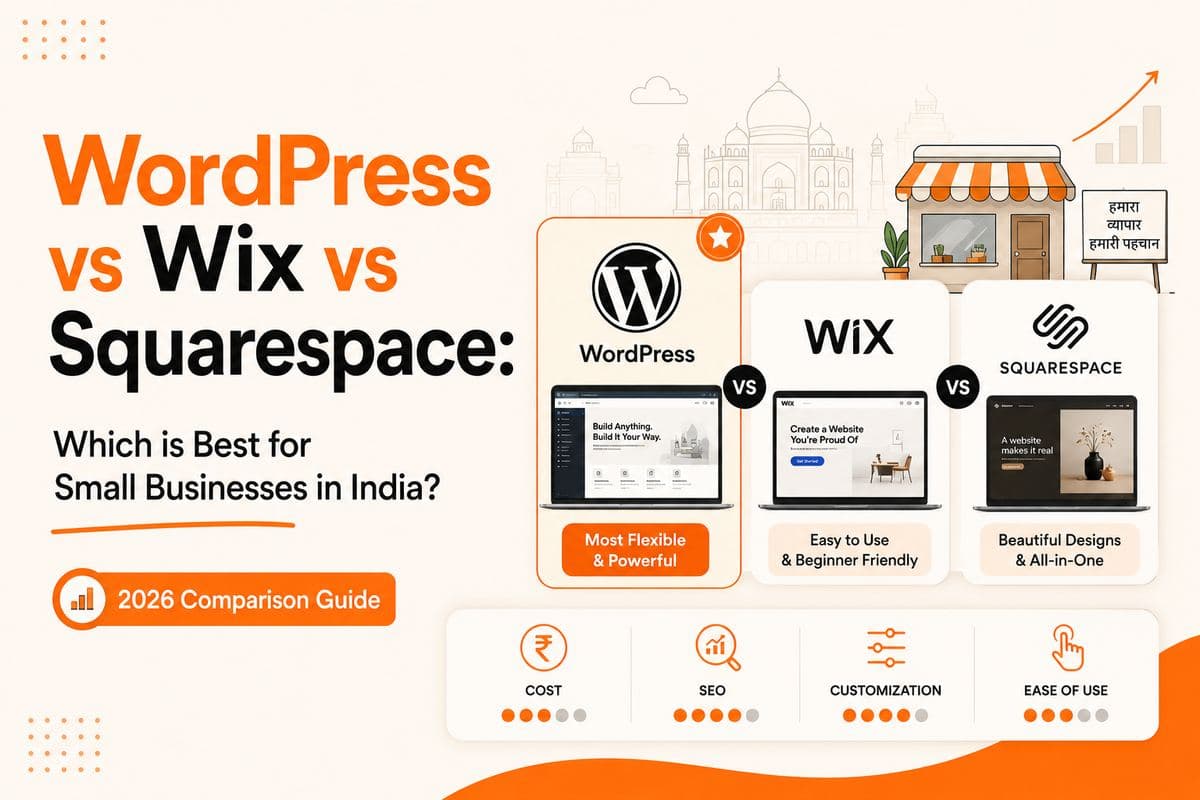
At some point in the journey of setting up a website, almost every Indian small business owner ends up staring at three names: WordPress, Wix, and Squarespace. They all promise a professional online presence, they all show beautiful demo sites, and they all have enough features to make the comparison feel impossible.
This article cuts through that. We'll compare all three on pricing in INR, SEO, payment support, flexibility, and long-term cost — with real numbers, not approximations. And because this is a comparison that matters specifically for Indian businesses (especially small ones), we'll be clear about what actually works here versus what looks good in an international review.
A Quick Reality Check Before the Comparison
WordPress, Wix, and Squarespace are not the same category of product — and that's the first thing most comparisons get wrong.
WordPress (specifically WordPress.org) is open-source software you install on a hosting server. You own it completely. It powers 43.4% of all websites on the internet and holds over 61% of the CMS market — more than Wix, Squarespace, Shopify, and every other platform combined. India and the USA each account for 246,000 monthly searches for "WordPress," making India one of the top countries for WordPress adoption globally.
Wix and Squarespace are SaaS website builders — you pay a subscription, they host your site, and you build it inside their locked ecosystem. Simple to start, but you don't own the underlying software.
That fundamental difference shapes everything else below.
Pricing in INR: What You Actually Pay
This is where the three platforms diverge sharply for Indian businesses, and where most international comparisons fail you.
WordPress
WordPress itself is free. Always. What you pay for is:
- Hosting: ₹2,500–₹8,000/year (shared to managed)
- Domain: ₹700–₹1,500/year
- Premium theme (one-time): ₹3,000–₹8,000 (optional; thousands of free themes exist)
- Total Year 1: ₹3,200 to ₹17,500 depending on your setup
For e-commerce, WooCommerce (the WordPress plugin) is also free to install. Payment gateway plugins for Razorpay, PayU, and UPI are either free or available for a small annual fee. No platform-level transaction fees beyond the gateway's own charges.
Wix
Wix offers four plans in India: Light at ₹199/month, Core at ₹399/month, Business at ₹799/month, and Business Elite at ₹1,599/month. All plans require annual billing and exclude GST. When billed annually, this works out to ₹2,388, ₹4,788, ₹9,588, and ₹19,188 per year respectively. Add 18% GST to each of these figures at checkout — so the Core plan (the minimum for e-commerce) actually costs closer to ₹5,649/year all-in.
The Light plan at ₹2,388/year does not support online selling. You need at least the Core plan to take payments, and UPI support is available through Nimbbl on Core and above.
Squarespace
This is where Indian businesses get a nasty surprise: Squarespace charges in USD. At current exchange rates, the Personal plan works out to roughly ₹1,300 to ₹1,500 per month on annual billing. Commerce plans run ₹2,300 to ₹4,300 per month.
That's ₹15,600 to ₹18,000/year just for the Personal plan — a plan that charges a 2% transaction fee on top of that. For an Indian small business, that's a significant recurring cost in a foreign currency that will fluctuate with the rupee-dollar exchange rate.
Squarespace also does not natively support UPI, Razorpay, or PayU. Payment is through Stripe or PayPal — which creates friction for Indian customers who expect UPI at checkout.
SEO: Where WordPress Wins Clearly
For local SEO — the kind that helps people in Malda or across West Bengal find your business when they search — platform choice genuinely matters.
WordPress gives you complete control over every technical SEO element: URL structure, page titles, meta descriptions, schema markup, site speed optimisation, robots.txt, XML sitemaps, structured data, and more. Plugins like Rank Math and Yoast make these accessible even without a developer.
Wix has improved its SEO significantly over the last two years. For basic on-page SEO, it's functional. But URL structures are less flexible, page speed on Wix tends to lag behind well-optimised WordPress sites, and advanced schema markup requires workarounds.
Squarespace has decent built-in SEO defaults but limited flexibility for technical customisation. You can't do things like custom schema injection without touching code, and some technical SEO setups that are standard on WordPress simply aren't possible.
If your main goal is ranking on Google — especially locally — WordPress is the stronger foundation.
E-Commerce for Indian Businesses: The UPI Problem with Squarespace
For any Indian business that wants to sell online, payment gateway support isn't a nice-to-have — it's essential. UPI has become the dominant payment method in India, and most customers expect to see it at checkout.
WordPress + WooCommerce supports Razorpay, PayU, CCAvenue, and several other Indian gateways as free or low-cost plugins. UPI, net banking, EMI options — all available natively.
Wix added UPI support through Nimbbl for the Indian market, available on Core plans and above. It's not as flexible as WooCommerce's gateway ecosystem, but it works for most standard store setups.
Squarespace relies on Stripe and PayPal. Stripe does support Indian businesses, but it adds a layer of friction — Indian customers are less familiar with it, conversion rates tend to be lower, and there's no native UPI checkout flow. For a small business in India where most customers pay via UPI or cards through Razorpay, this is a real disadvantage.
Flexibility and Ownership: The Long-Term Consideration
Here's something most platform comparison articles skip: what happens when you want to change something three years from now?
With WordPress, you own everything. Your content, your design, your code, your database. You can switch hosts, change developers, add any feature imaginable, and move your site to a different setup at any time. There are over 64,000 free plugins available in the WordPress directory, covering almost anything a business could need.
With Wix or Squarespace, you're renting space inside someone else's system. If Wix changes its pricing (they have, multiple times), you pay the new rate or start over. If a feature you rely on gets discontinued, you work around it or leave. Your site content lives inside their proprietary format — migration to another platform is possible but painful.
For a small business planning to stay online long-term and grow, that ownership question matters.
Who Should Use What
WordPress is the right choice if:
- You want full control over your website's SEO and design
- You're building a store and need Razorpay or UPI natively
- You're thinking long-term and want to own your platform
- You have a developer (or agency like us) handling setup and maintenance
- You plan to create ongoing blog content for organic search growth
Wix is a reasonable choice if:
- You want to build something simple yourself without any technical help
- Your site needs are straightforward (5–8 pages, basic catalogue)
- You want INR pricing with UPI support
- Speed to launch matters more than long-term SEO flexibility
Squarespace makes sense if:
- Aesthetics are the absolute priority (it genuinely has the best-looking templates)
- Your customers are international and comfortable with Stripe/PayPal
- You're a photographer, designer, or creative professional who wants a portfolio site
- USD billing isn't a concern for your budget
For most Indian small businesses — shops, manufacturers, service providers, exporters, restaurants, hotels — WordPress hits the right balance of cost, control, and long-term value. The steeper learning curve at the start pays back over time in a way that a locked SaaS platform simply can't match.
One More Number Worth Knowing
WordPress powers 43.4% of all websites on the internet — more than all other platforms combined. Its nearest competitor, Shopify, holds 4.8%, followed by Wix at 3.7% and Squarespace at 2.3%.
That dominance isn't an accident. It reflects decades of developers, designers, and business owners choosing a platform they can build on — and keep building on — without asking anyone's permission.
Get a Free Quote — Based in Malda, Serving All of West Bengal
At Electen Agency, we specialise in WordPress development for small businesses across Malda and West Bengal. If you're weighing your platform options and want an honest, pressure-free conversation about what makes sense for your specific business, we're happy to help.